

Fast horses
Agents are hyper-communicative polyglot polymaths with photographic memories - not faster horses.

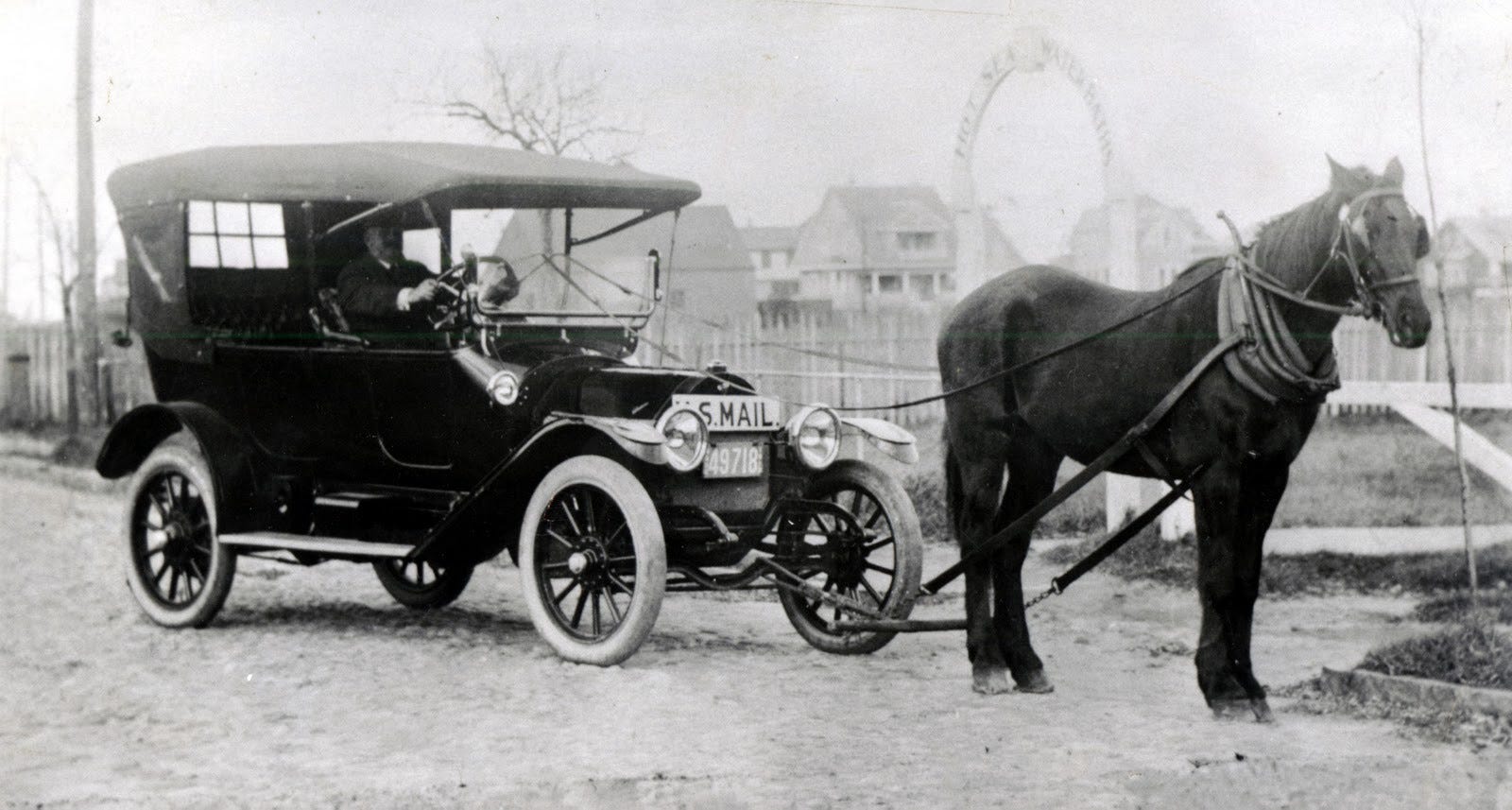
According to folk law, Henry Ford didn’t do market research. “If I had asked people what they wanted, I would have built faster horses”, he’s rumoured to have said. Sometimes people only know what they need when they see it.
Are we in danger of viewing AI through the lens of faster horses? Imagining teams of agents mirroring human activities in corporate departments with job titles and org structures?
Thinking of agents in terms of traditional roles obfuscates the true promise of this uniquely generalisable technology. Many popular AI metaphors invoke poor mental models for this wave of disruption, they aren’t just stretched analogies, they’re category errors.
The resulting misclassification risks more than just failed implementations and missed opportunities. It risks human burnout, as management and control mechanisms are misapplied to cheap, non-human agents operating at machine speed
Category error 1, agents should have roles and teams, like people.
✳️ Agents don’t need teams. They need constraints.
The world of work was never cast in stone. It has fundamentally changed in a few generations from manual labour to knowledge work. Change has only accelerated in this generation, with the adoption of new methods and technologies like lean, just in time, the internet and digitisation.
Through trial and error, research and iteration, we have developed organisational topologies and processes that reflect human cognitive and social constraints. We evolve methods of organisation to suit the activity and technology.
Small teams leverage specialist knowledge and operate within trust boundaries to create output. Many teams combine to create tradable products and services. Organisations create value in their core competance which are combined in supply chains with market ecosystems delivering items to the consumer. Quality control frameworks manage inconsistency and error, while project and innovation pipelines orchestrate new value creation.
This is surely progress but the very trust boundaries and specialisation that define modern organisations create artificial silos that only make sense in the context of human cognition and sociology.
Agentic teams
In some respects large language models exhibit alarmingly human like behaviours. They never let the truth get in the way of a good story, respond creatively under uncertainty and miscommunicate.
We describe these phenomenon in very human terms - hallucination, reasoning, misunderstanding - and apply very human controls like fact checking. This works to an extent. He et al. (2024) find that systems with evaluator or critic agents can improve performance in software engineering tasks.
The temptation is to extrapolate these similarities into agent structures that mirror human organisations. We have development teams and test teams, so we’ll create coding agents and testing agents. We have analysts, project managers and executives, so we construct their agentic equivalents.
There are many frameworks that follow this pattern; MetaGPT, Microsofts agent teams and CrewAI are good examples. These structures are conceptually comfortable, but agents are not people.
He et al. (2024) also highlight that multi-agent systems introduce non-trivial coordination and communication challenges, increasing system complexity and making reliable orchestration difficult.
Anthropic’s work on agent design hints at a deeper category error. As model capability improves, systems built around multiple interacting agents are often outperformed by far simpler architectures.
Simple orchestrations are faster, more reliable, and less brittle because they avoid the coordination overhead inherent in multi-agent designs. We may view agent teams with roles and hierarchies as progress, but this may simply reflect our tendency to project human organisational structures onto systems that operate by entirely different principles.
Gas Town
Steve Yeggie’s agent orchestrator “Gas Town”, models agents on roles inspired by oil rigs, films and other narratives. For example; Mayor, Polecats, Witnesses and Mariners (the only lasting thing to come out of Costner’s Watereorld epic). But the metaphor is deliberately loose. It’s scaffolding for behaviour, not a blueprint for organisation.
In practice, the system works best when it breaks from the analogy.
Agents are not long-lived actors but ephemeral sessions, “cattle” restarted continuously, with all state externalised into shared workflows. Coordination happens through persistent tasks and acceptance criteria, not chains of command. Even structurally, Gas Town avoids depth: most work operates across just two levels, with orchestration replacing hierarchy.
Early practitioners are already converging on the same lesson. Attempts to recreate full organisational stacks analyst → PM → architect → developer → QA — quickly collapse under their own complexity. The systems that work use fewer roles, flatter structures, and treat coordination as an infrastructure problem, not a human one.
The metaphor is useful. But taking it literally is a category error.
So if verifier agents improve quality, why do agent teams modelled on human organisations often fail to deliver?
Category error 2, agent verifiers are like human testers
✳️ Agent verification is not a quality gate - it’s the system.
Emerging research shows multi-agent systems, including those with evaluator or critic components, can improve outcomes in certain domains, particularly in software engineering, Benkovich (2026).
This reinforces the concept of QA roles within agent teams. But improvements arise from iterative evaluation and refinement within tightly coupled DevOps style pipelines, not from the introduction of human-like QA roles or organisational separation. To be fair the more enlightened engineering orgs also steer away from siloed dev and test functions in favour of moving testing into the development workflow (shifht left and build quality in).
Furthermore these models diverge from human team topologies. Benkovich notes that agents should only communicate via an orchestrator agent, not with each other. Wheres interaction between human developers is the very point of pizza sized teams - even if that communication is via IM with headphones on.
Traditional QA organisations evolved to address constraints on human cognition - limited memory, limited attention, and the need for independent validation.
The mental model of one agent checking another agent’s work mirrors traditional QA, but is misleading. Agent verification is closer to continual optimisation, analogous to the scientific method at machine speed.
Agent verification is not a checkpoint. It is part of the system that iterates until defined success criteria are met.
Frontier models already apply this pattern in chain-of-thought reasoning. Outputs ranging from code and marketing content to strategic analysis are generated, evaluated and refined within internal loops before being surfaced.
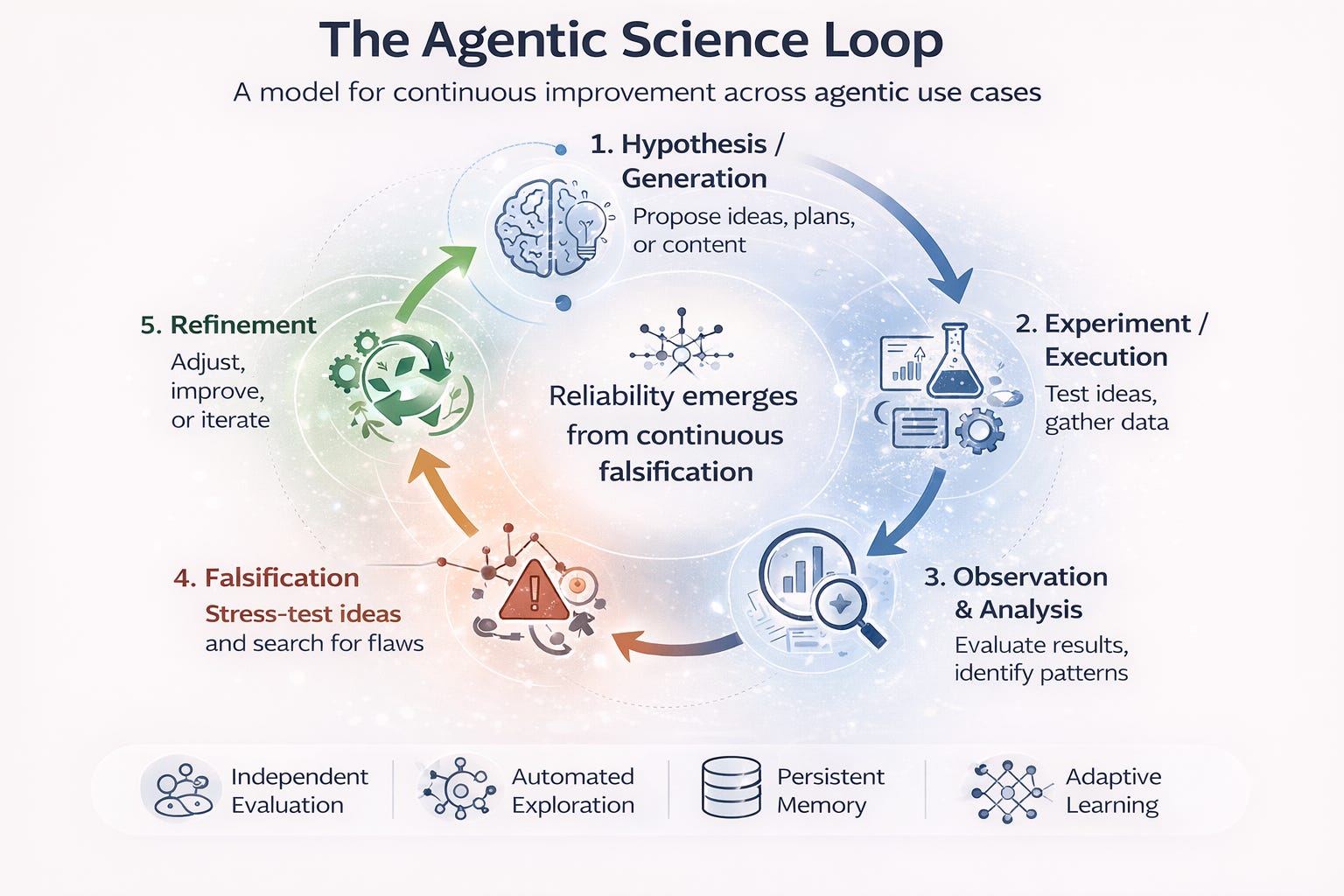
Verification in this sense is not quality control. It is a control system.
Effective use of agents means defining and auditing success criteria. Managing agent teams as if they were human teams, causes cognitive overload and burn out.
Category error 3, AI is just automation
✳️ AI unlocks more value by coordinating work, than automating it..
This is perhaps the most consequential misclassification.
We have seen various waves of automation before, where machines replaced or accelerated human tasks. Factory robots, workflow systems and software automation all improved efficiency within existing organisational structures.
AI is often framed in the same way — as automation for knowledge work.
But this framing is incomplete.
Traditional automation improved individual tasks - making steps faster, cheaper or more reliable. Human organisations coordinate those automations into products and services.
AI introduces a different dynamic. Rather than simply improving execution, it reduces the coordination required between processes. Workflows that previously required multiple roles, handoffs and interdisciplinary communication can be collapsed into tighter, faster, more integrated systems.
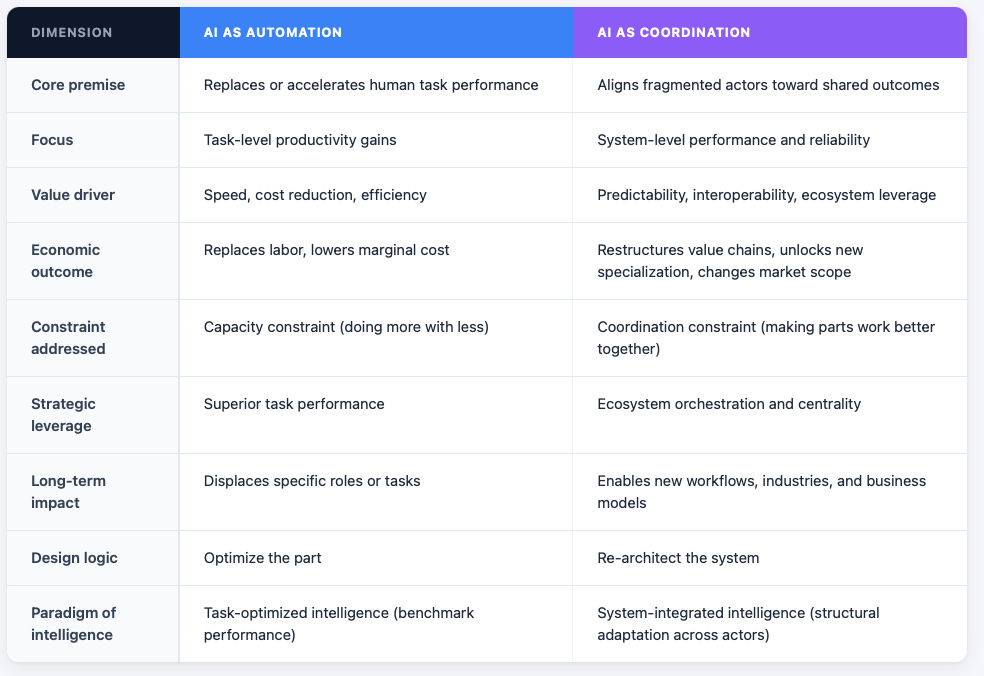
This helps explain why organisations that successfully adopt AI often flatten their structures. This is not a side-effect of task automation, it reflects a reduction in coordination overhead.
Traditional automation alleviated capacity constraints. AI reduces coordination constraints as well. This distinction matters.
When coordination costs are reduced, benefits compound across multiple stages of a process. Efficiency gains occur not just within tasks, but at every handoff between tasks, teams and even markets.
This is where the economic impact becomes significant.
Farach (2026) models AI as “coordination-compressing capital”, showing how reductions in coordination overhead can materially change the structure of firms and markets. At relatively modest levels of AI capability, coordination costs per worker fall significantly, with diminishing returns as automation approaches full replacement (below).
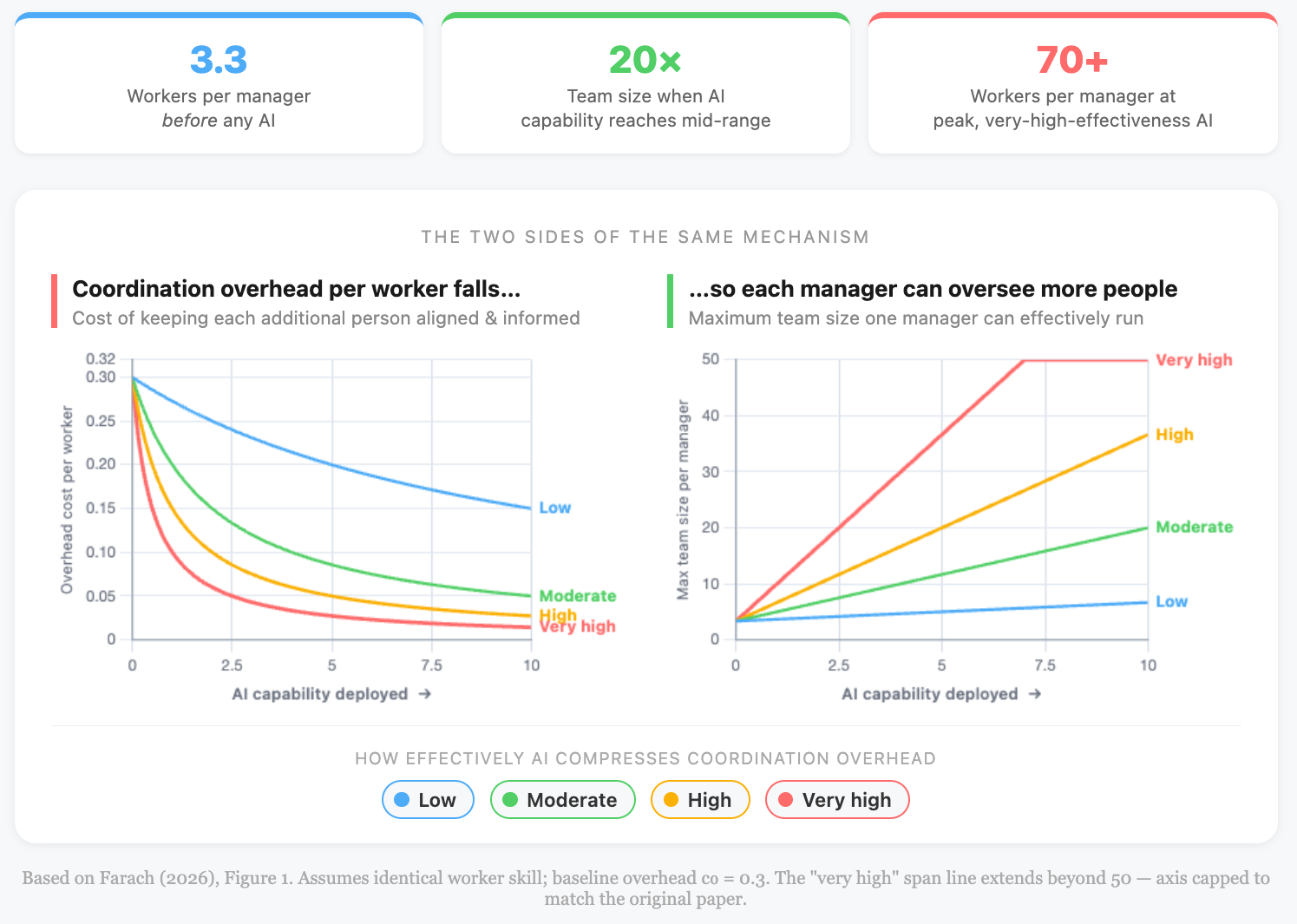
The implication is not just better productivity — but new organisational possibilities.
We often overestimate AI’s potential for automation, applying it to tasks where it performs poorly and fueling cycles of hype and disillusionment. At the same time, we consistently underestimate its potential for coordination. With this framing error, we chase narrow performance benchmarks and, in the process, overlook AI’s true economic potential in restructuring how people, teams, and companies coordinate to create value. We fixate on individual tasks and job substitution, rather than asking which coordination failures AI can resolve and what new forms of economic activity get unlocked once those coordination frictions are eliminated. - Choudary, (2023)
References & Further Reading
Anthropic. (n.d.). Demystifying evals for AI agents. Anthropic Engineering.
Anthropic. (n.d.). Effective harnesses for long-running agents. Anthropic Engineering.
Anthropic. (2024). Building effective agents. Retrieved from https://www.anthropic.com/engineering/building-effective-agents
Anthropic Red Team. (2026). Property-based testing. Anthropic Red Team.
Benkovich, A., et al. (2026). Agyn: An agentic framework for software engineering. arXiv.
Choudary, S. P. (2023). Reshuffle: Who wins when AI restacks the knowledge economy. Platformation Labs.
Chen, Z., et al. (2026). Rethinking the value of agent-generated tests. arXiv.
Choudary, S. P. 2023 . Reshuffle with Sangeet Paul Choudary. BCG Henderson Institute.
Dell’Acqua, F., et al. (2024). Navigating the jagged technological frontier: Field experimental evidence of the effects of AI on knowledge worker productivity and quality. Harvard Business School.
Farach, J. (2026). AI as coordination-compressing capital. arXiv.
Google DeepMind. (n.d.). Introducing CodeMender: An AI agent for code security. Google DeepMind.
Google Research. (n.d.). VeriGuard: Enhancing LLM agent safety via verified code generation. Google Research.
Hadfield, G., et al. (n.d.). An economy of AI agents. In NBER.
Havstorm, C., et al. (n.d.). Software development method cargo cult in agile practices. SSRN.
He, Q., et al. (2024). LLM-based multi-agent systems for software engineering: Vision and the road ahead. arXiv.
OpenAI. (n.d.). Codex. OpenAI.
OpenAI. (n.d.). Introducing Codex. OpenAI.
Pereira, J., et al. (2026). CR-Bench. arXiv.
Royce, W. W. (1970). Managing the development of large software systems. In Proceedings of IEEE WESCON.
Shen, A., & Tamkin, A. (n.d.). How AI impacts skill formation. Anthropic.
Sehn, T. (2026). A day in Gas Town. DoltHub Blog.
Yegge, S. (2026). Gas Town: Multi-agent orchestration system for Claude Code with persistent work tracking [Computer software]. GitHub.
Yegge, S. (2026). Welcome to Gas Town. Medium.
Curated research
Gas town explainer: https://anthonywest.co.uk/explainers/folders/ai-engineering/2026-03-19_yegge_gas-town_explainer
https://anthonywest.co.uk/research/engineering-ai-control-plane